Best Weather for Stargazing: Ideal Conditions & How to Check Them
Finding the best weather for stargazing starts with more than a clear night. Low cloud cover, dry air, light winds, and stable atmospheric conditions can make stars easier to see. Moonlight and light pollution also affect visibility. Knowing what to check can help you choose the right night and viewing time. Here’s how to check these conditions with GoWeatherRadar - discover now!
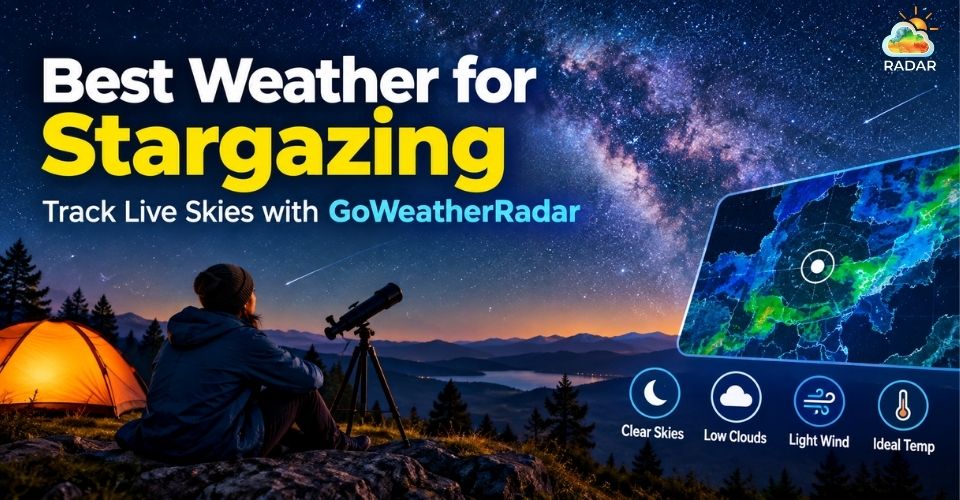
Best weather for stargazing
Quick Takeaways
Here are the best weather conditions for perfect stargazing:
-
Cloud Cover: Near-zero or very low cloud cover provides the clearest view of the night sky.
-
Humidity & Dew Point: Lower humidity and dew point generally mean less haze and better sky transparency.
-
Atmospheric Stability: Stable air helps reduce turbulence and improves views through a telescope.
-
Wind: Light winds are preferable for comfortable viewing and steadier telescope observations.
-
Atmospheric Pressure: High-pressure systems often bring clearer and more stable weather.
-
Moon Phase: A New Moon or thin crescent creates darker skies for viewing faint stars.
-
Light Pollution: Dark locations away from cities offer better visibility of stars and the Milky Way.
-
Darkness: Wait until astronomical twilight ends for the darkest possible sky.
Best Weather for Stargazing: Core Weather Factors
Several weather factors can affect how clearly you see the night sky.
Low cloud cover is the most important, while humidity, transparency, atmospheric stability, wind, and air pressure also play a role.
|
Weather Factor |
Ideal Condition |
Why It Matters |
|
Cloud Cover |
Near 0% or very low |
Keeps the sky clear and helps you see more stars. |
|
Humidity & Dew Point |
Relatively low |
Reduces haze and improves sky transparency. |
|
Transparency |
Clear air with little haze, smoke, or dust |
Allows light from faint stars and the Milky Way to pass through more clearly. |
|
Atmospheric Stability (Seeing) |
Stable, low-turbulence air |
Reduces star shimmer and image distortion through a telescope. |
|
Wind |
Light winds |
Provides more comfortable conditions and can support steadier telescope viewing. |
|
Barometric Pressure |
High-pressure conditions |
Often brings sinking, stable air and fewer clouds. |
No single weather factor guarantees perfect stargazing. For the best results, check several conditions together, especially cloud cover, transparency, and atmospheric stability.
How to Check Stargazing Weather Using GoWeatherRadar
Once you know which conditions matter, GoWeatherRadar can help you check them on one interactive map.
The platform provides cloud, humidity, wind, pressure, rain, and other weather layers, with forecast data powered by the ECMWF model.
You can also move through the timeline to compare conditions at different hours.
Learn more about the weather radar application to see how radar can support everyday weather decisions.
Step 1: Check Cloud Cover and Cloud Movement
Start with the Cloud layer to see how much of the sky is covered and where cloud systems are moving.
Use the timeline at the bottom of the map to check how conditions may change during your planned stargazing session.
Look for periods with little cloud cover rather than checking only the current conditions.
A location that is cloudy now may clear later, while a clear sky can become overcast as clouds move in.
→ Check the Cloud Radar Map
Step 2: Check Humidity
Next, switch to the Humidity layer. GoWeatherRadar displays moisture levels visually, making it easier to compare conditions across different areas.
For stargazing, favor areas with relatively lower humidity and dew point when other conditions are similar.
Drier air can reduce haze and support better atmospheric transparency.
However, humidity should be considered together with cloud cover and air quality rather than treated as a single pass/fail value.
Step 3: Monitor Wind and Pressure
Turn on the Wind layer to check wind speed and direction. The map uses moving lines and color bands to show airflow, while the scale helps you understand wind intensity.
Light winds are generally more suitable for comfortable stargazing and can support steadier telescope observations.
Then check the Pressure layer. High-pressure areas are often associated with sinking, stable air and fewer clouds.
GoWeatherRadar uses color-coded pressure data and lets you view changes across the forecast timeline.
Note: The best approach is to combine the layers. Look for a period with low cloud cover, relatively dry air, light winds, and stable or high-pressure conditions rather than relying on pressure alone.
Step 4: Check Rain and Precipitation
Finally, check the Rain layer before heading outside. GoWeatherRadar shows precipitation on the map and lets you move through the forecast timeline to see when rain may develop or move into your area.
A clear sky forecast is much more useful for stargazing when it is also free from incoming rain or storms.
By checking these layers together, you can compare different hours and find a better stargazing window instead of relying on a single weather forecast.
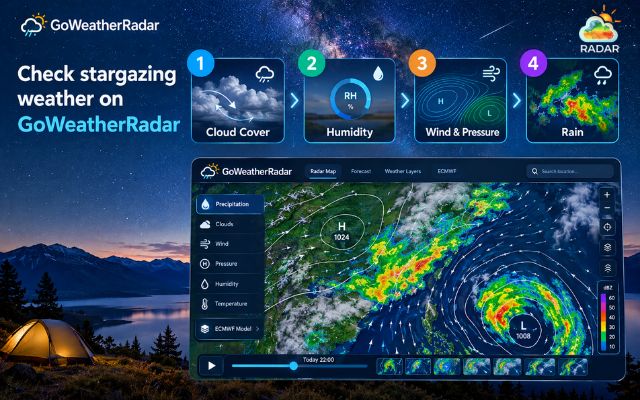
Easily check sky condition on GoWeatherRadar
You may also like
Non-Weather Conditions to Consider
Weather is only part of the stargazing picture.
-
Moon phase can have a major effect on how many stars you can see.
A New Moon or a thin crescent produces a darker sky. A bright Full Moon can wash out faint stars and make deep-sky objects harder to observe.
-
Light pollution is another major factor.
City lights brighten the night sky and reduce the visibility of faint stars. If possible, travel away from urban areas and choose a location with darker skies.
Finally, consider darkness. Wait until astronomical twilight has ended, when the Sun is far enough below the horizon for the sky to become fully dark.
Combining darkness with low cloud cover, good transparency, and stable weather can give you much better stargazing conditions.
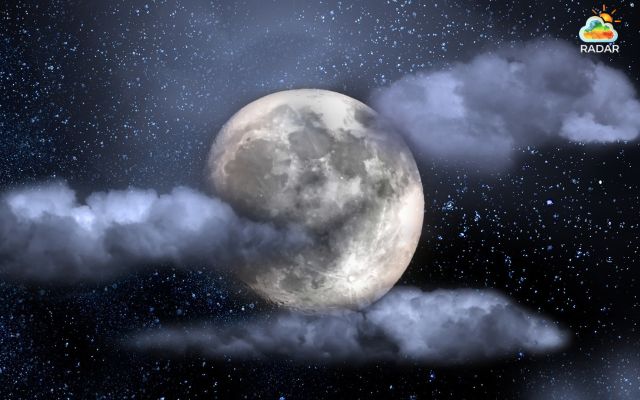
Moon phase and light pollution also affect stargazing condition
Sum up
The best weather for stargazing combines very low cloud cover, dry and transparent air, light winds, stable atmospheric conditions and no precipitation. For the darkest sky, choose a night with little moonlight and low light pollution. Checking these conditions together is more useful than relying on a single weather metric. For a perfect stargazing night, do not forget to check GoWeatherRadar!


0 Comments
Leave a Comment
Your email address will not be published. Required fields are marked *